Buying a Home in an HOA The Real Pros and Cons in 2026

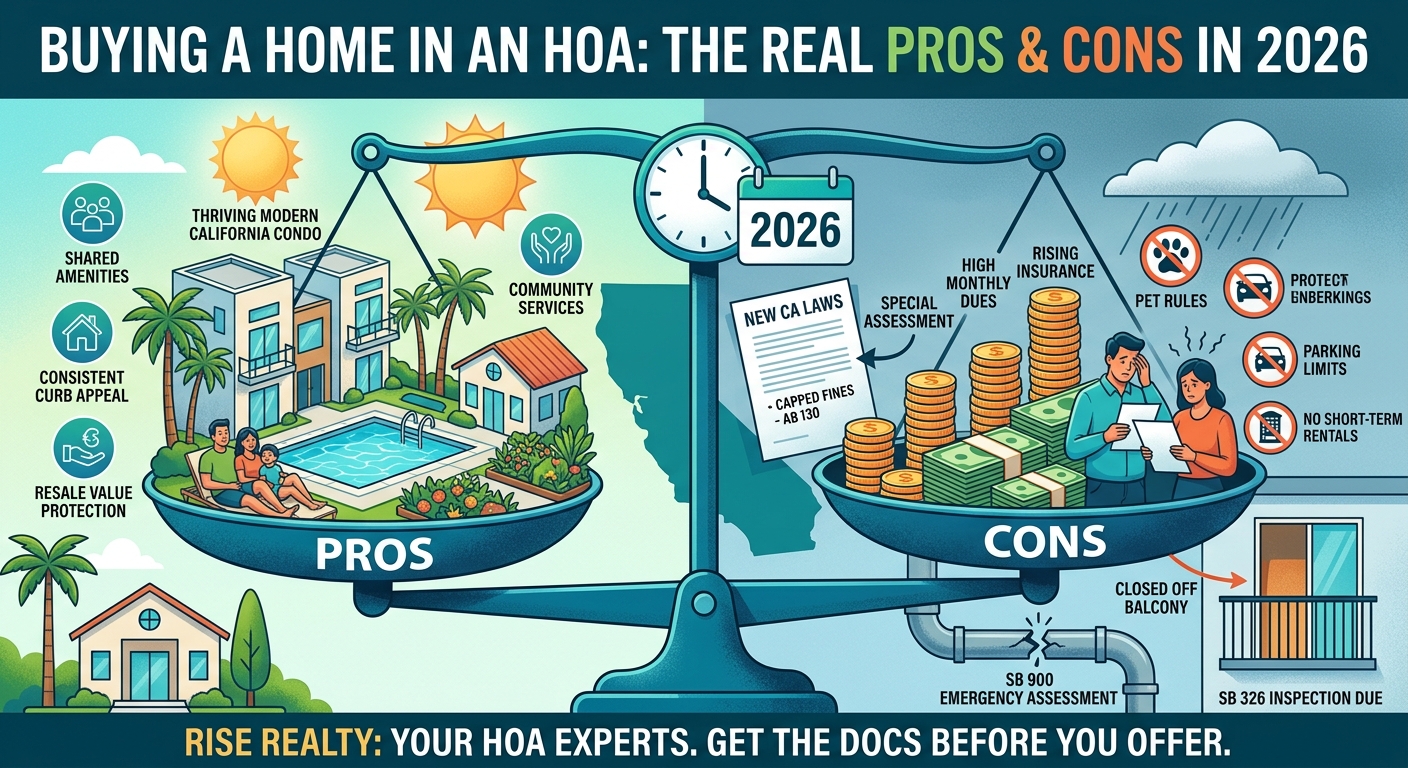
Buying a Home in an HOA: The Real Pros and Cons in 2026
A large share of California condos, townhomes, and planned communities come with a homeowners association attached, and whether that's a genuine benefit or a real risk depends heavily on the specific HOA, not on HOAs as a category. 2026 is a particularly relevant year to ask this question honestly: new state laws around fines, balcony inspections, and emergency assessments have shifted what buyers should actually check, and rising insurance costs are pushing some associations toward special assessments buyers don't see coming until after they've closed. Here's what's actually true on both sides right now.
What an HOA Actually Does For You
The genuine upsides are real, not just marketing language. An HOA typically maintains shared amenities, common landscaping, private roads, and exterior building elements, which protects curb appeal and, by extension, resale value across the whole community more consistently than an area of standalone homes with no shared standards. Many HOAs also provide amenities, pools, gyms, gated security, clubhouses, that would be expensive to build and maintain on your own. And when a genuine neighbor dispute or maintenance disagreement comes up, an HOA gives you a formal process to resolve it rather than leaving it to informal negotiation.
What's Actually Changed for HOAs in California in 2026
Several new rules take effect or come into sharper focus this year, and they cut in different directions for buyers.
| Change | What It Means for Buyers |
|---|---|
| SB 326 — mandatory balcony inspections | Condos with 3+ units and wood-supported elevated elements 6+ feet high need licensed inspections by January 1, 2026. Ask whether your building has completed this and what it found. |
| AB 130 — capped HOA fines | Most fines for non-safety rule violations are now capped at $100 per violation, with required internal dispute resolution before enforcement. Good for homeowners; some boards have reportedly frozen enforcement altogether while adjusting. |
| SB 900 — emergency assessments | Allows emergency special assessments without a member vote when reserves are insufficient for essential utility line repairs. This can mean a real bill arrives with little warning. |
| Rising insurance premiums | Wildfire risk, higher construction and claims costs, and a shrinking pool of carriers are pushing HOA insurance premiums up statewide, especially in higher-risk areas. |
Source: California legislative summaries of SB 326, AB 130, and SB 900; California HOA insurance market analysis, 2026.
The Real Negatives to Weigh
Monthly HOA dues are a real, ongoing cost that belongs in your affordability math the same way property taxes and insurance do, not as an afterthought once you've already fallen for a listing. Beyond the predictable monthly cost, the bigger financial risk is the special assessment: an unbudgeted, sometimes large one-time bill when the reserve fund can't cover a major repair. Some California communities have faced special assessments in the range of $40,000 to $60,000 per unit for major deferred-maintenance or safety repairs in recent years, a figure that can upend a buyer's entire financial plan if it arrives unexpectedly. Beyond money, CC&Rs can restrict things that matter to you personally, exterior modifications, parking, pet rules, and in some communities, short-term rentals, and a poorly run or contentious board can make day-to-day life genuinely frustrating regardless of the amenities on paper.
What to Actually Check Before You Buy in an HOA
- Reserve study and funding level. Ask what percentage of the recommended reserve is actually funded. A poorly funded reserve is the single biggest predictor of a future special assessment.
- Recent meeting minutes. These often reveal pending litigation, planned assessments, or maintenance problems well before they show up in official disclosures.
- Current financial statements and budget. Look for whether dues have been rising faster than typical inflation, which can signal underlying cost pressure.
- The CC&Rs themselves. Read the actual restrictions on rentals, pets, exterior changes, and parking rather than relying on what a listing agent tells you verbally.
- Insurance certificate and master policy coverage. Confirm what the HOA's policy actually covers versus what you'd need your own individual policy to cover.
- Any pending special assessments or balcony/building inspection results. Especially relevant given SB 326's January 2026 deadline for qualifying buildings.
Frequently Asked Questions
Are HOA fines capped now in California? Yes, as of AB 130, most fines for non-safety rule violations are capped at $100 per violation, and associations must complete an internal dispute resolution process before formal enforcement.
Can an HOA charge me a special assessment without a vote? In some cases, yes. SB 900 allows emergency special assessments without a member vote specifically when reserves are insufficient to cover essential utility line repairs; other types of assessments generally still require a vote per the association's governing documents.
How do I know if an HOA is financially healthy before I buy? Request the reserve study, current financial statements, and recent meeting minutes. A well-funded reserve and no mention of pending large assessments are good signs; a poorly funded reserve is the biggest red flag.
Are HOA dues included when a lender calculates what I can afford? Yes. Lenders include HOA dues in your debt-to-income calculation the same way they include property taxes and insurance, so a home with high dues effectively qualifies you for a lower purchase price than the same home without them.
Bottom Line
An HOA isn't automatically good or bad, it's a real trade of some control and unpredictability for shared maintenance, amenities, and consistency, and 2026's new laws shift that trade in a few specific ways: capped fines protect homeowners, but emergency assessment authority and rising insurance costs raise the stakes of buying into a poorly funded association. The reserve study and recent meeting minutes are the two documents that tell you the most before you commit.
Considering a home in an HOA community? Set up a saved home search with Rise Realty and we'll help you pull the actual HOA documents before you write an offer, not after.
Sources
- California SB 326, mandatory balcony and elevated-element inspection requirements
- California AB 130, HOA fine caps and dispute resolution requirements
- California SB 900, HOA emergency special assessment provisions
- California HOA insurance market and reserve funding analysis, 2026
Categories
Recent Posts