The Real Economics Behind Cloud-Based Brokerages in 2026

The Real Economics Behind Cloud-Based Brokerages in 2026
The National Association of Realtors' 2026 member profile found that the typical Realtor now has 13 years of experience, up from 12 the year before, and that 53% of members are affiliated with independent brokerages rather than large franchise networks. Median tenure with a current firm sits at six years. Read together, those numbers describe an industry where a lot of agents are, or should be, asking the same question: does my current brokerage's cut of my commission still buy me anything I couldn't get elsewhere for less? That question is the actual engine behind the shift toward cloud-based, 100% commission models, and it's worth walking through the real math rather than the marketing version.
Why the Traditional Split Math Is Under Pressure
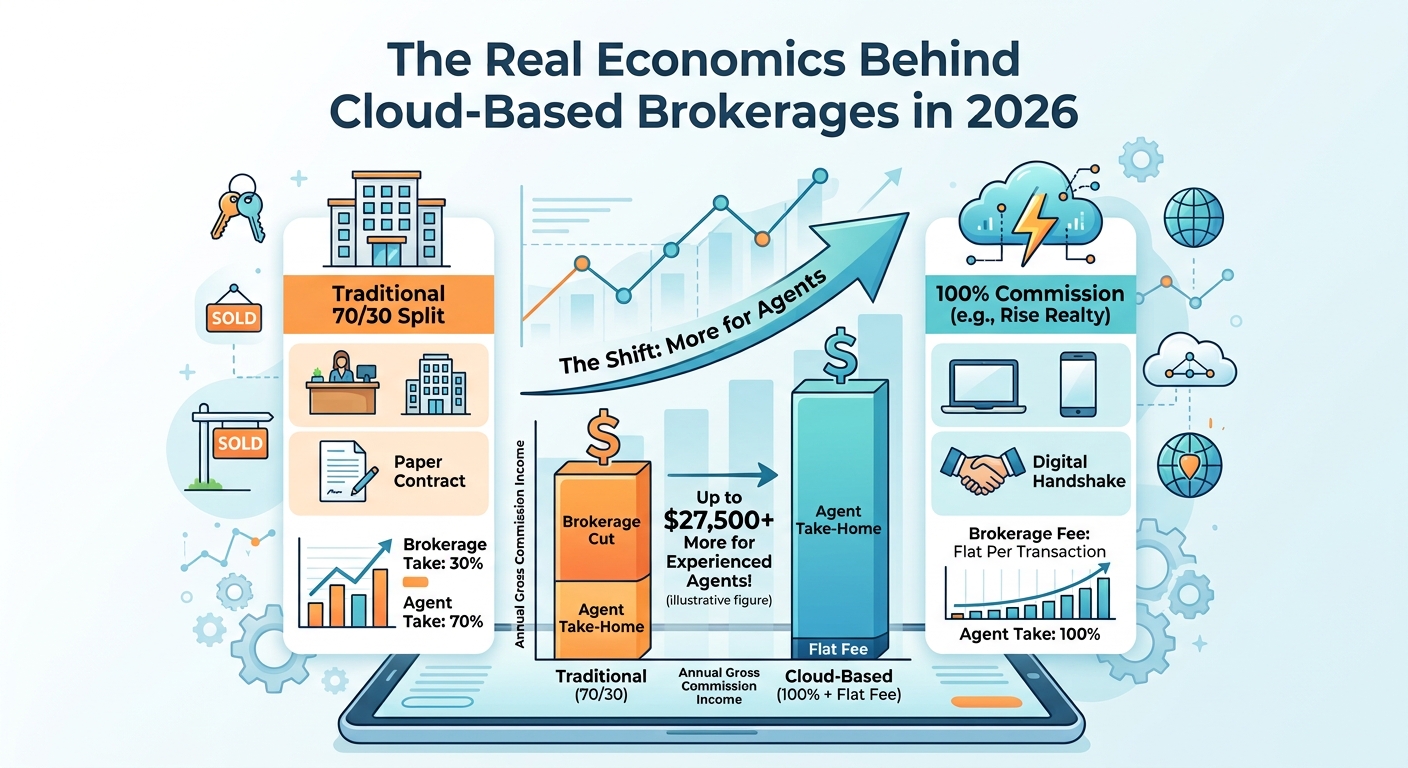
A traditional 70/30 commission split sounds modest until you run it against real numbers. On $125,000 in gross commission income over a year, a 70/30 split leaves the brokerage with $37,500 before the agent sees a dollar of it. Under a 100% commission model charging a flat per-transaction fee, say $500 across 20 closed transactions in that same year, the agent pays $10,000 total and keeps $115,000. That's a $27,500 gap on identical production, and it's the single biggest reason this conversation keeps coming up at every level of the industry.
| Model | Brokerage Take on $125,000 GCI | Agent Take-Home |
|---|---|---|
| Traditional 70/30 split | $37,500 | $87,500 |
| 100% commission, $500/transaction fee (20 deals) | $10,000 | $115,000 |
Illustrative example based on $125,000 in gross commission income and 20 closed transactions in one year. Your own numbers will depend on your production, transaction fee structure, and brokerage's specific model; this is a framework for comparison, not a quote.
What's Actually Driving the Shift to Cloud-Based Models
The split math is the headline, but the reason it's changeable at all is infrastructure. A decade or two ago, MLS access, CRM tools, transaction management software, and marketing systems genuinely required a traditional office to provide them. That's no longer true. MLS access is available through flat-fee broker affiliations, CRM and transaction management platforms are subscription software an individual agent can license directly, and an agent's own online reputation and referral network increasingly carry more weight with clients than which brokerage's sign is in the yard. When the infrastructure a brokerage used to be the only source of becomes available a la carte, the brokerage's percentage has to justify itself on something other than access alone.
Who This Shift Actually Benefits, and Who It Doesn't
This isn't a universal upgrade for every agent, and honest analysis should say so directly. The commission-retention math favors agents with established production and existing referral pipelines, mid-career and veteran agents who no longer need a brokerage's lead flow or hands-on training to close deals. Brand-new agents are a different story: without production history or referral relationships yet built, the mentorship, structured onboarding, and lead support a brokerage provides can matter more than a few extra points of commission on a still-small deal volume. The real question for any individual agent isn't "is cloud-based better," it's "does what my current brokerage actually provides still justify what it costs me at my current production level."
What a Well-Built Cloud-Based Model Still Needs to Deliver
Lower overhead only helps if the brokerage still delivers real compliance oversight, genuine mentorship access, and functioning transaction support, just without the physical office. Rise Realty's tiered structure, including its PREMIER, RISE 100, and MENTOR programs, is built around keeping those pieces intact for agents at different production levels and experience stages rather than treating "cloud-based" as an excuse to strip support down to nothing.
Frequently Asked Questions
Is a 100% commission brokerage actually cheaper for every agent? Not automatically. It's typically most advantageous for agents with steady production and existing referral relationships; newer agents may get more net value from a traditional split that includes heavier mentorship and lead support.
Why are more experienced agents specifically drawn to this model? Because the infrastructure a traditional brokerage used to uniquely provide, MLS access, CRM tools, transaction platforms, is now available independently, so a brokerage's percentage increasingly has to be justified by something beyond access alone, and experienced agents are best positioned to make that trade.
Does switching to a cloud-based brokerage mean less oversight or compliance support? It shouldn't, at a brokerage that takes it seriously. Real supervision and compliance review are a legal requirement regardless of the office model, and a well-run cloud-based brokerage delivers them through online systems rather than in-person check-ins.
What should an agent actually compare before switching brokerages? Their current commission split and fees against actual production, what specific support (mentorship, lead sources, tools) they use and would lose, and what a target brokerage genuinely provides versus what's just marketing language.
Bottom Line
The shift toward cloud-based, 100% commission brokerages isn't a trend built on hype, it's built on infrastructure that used to require a traditional office no longer requiring one, and on commission math that experienced agents can now run for themselves. The agents for whom it makes the most sense are the ones with production and referrals already in place; newer agents should weigh mentorship and support just as heavily as the percentage. At Rise Realty, we've built our cloud-based model specifically to keep real support in place at every stage. Learn more about joining Rise Realty and run the numbers for your own production.
Sources
- National Association of Realtors, 2026 Member Profile, as reported by HousingWire
- Industry commission-economics analysis of traditional split versus 100% commission fee structures
Recent Posts